March 5, 2026 · 9 min read
Why anti-acne creams don't work (and what nobody tells you)
You've probably already tried several anti-acne creams.
Some seemed to work… for a few days. Others changed nothing. And sometimes, things even got worse.
So you switch products. Then again. And in the end, nothing lasts.
It's not a coincidence. And it's not your fault.
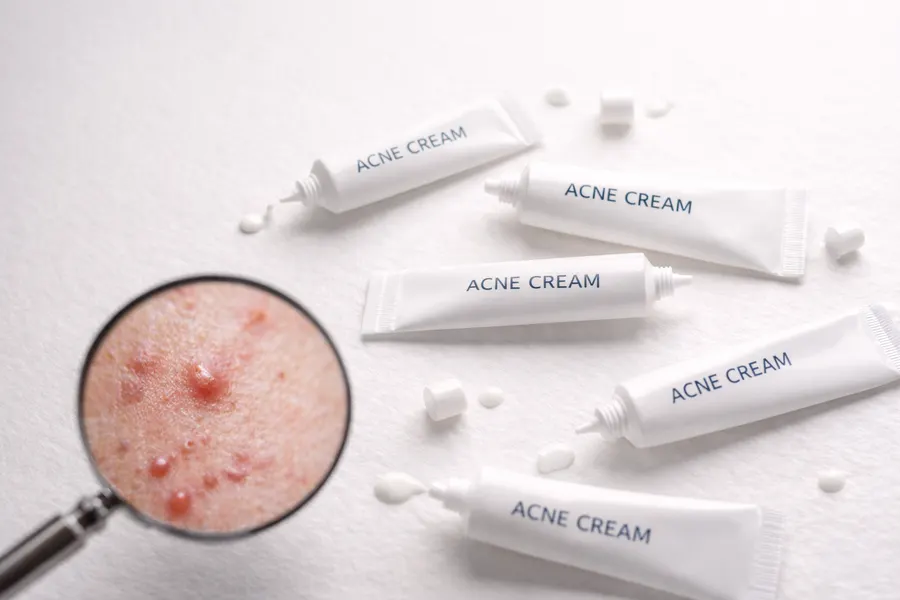
Creams act on the surface — but the problem forms deep down
The big myth: "finding the right cream"
You're told that all you need is to find "the right cream". The one that will finally eliminate spots, regulate skin, solve the problem.
But this idea rests on a fundamental error.
A cream alone cannot solve a problem that forms beneath the skin.
Why creams sometimes create the illusion of working
Some creams give visible results quickly. They can:
- Dry out imperfections
- Reduce inflammation
- Temporarily smooth the skin
But what you see is only the surface. The problem is often still present deep down.
The problem nobody explains: the skin barrier
Skin is designed to protect itself. Its outer layer acts as a barrier. And this barrier severely limits the penetration of active ingredients.
Concretely:
- Most ingredients stay on the surface
- Only a small portion actually penetrates
- And rarely where the problem develops
Applying more product changes nothing
When results are insufficient, the reflex is often the same: apply more, more often, or switch products.
In reality:
Applying more product on skin that can't absorb it changes nothing.
- ✕Active ingredients stay on the surface
- ✕They don't reach their target
- ✕The problem persists
Why results never last
That's where the cycle begins: skin improves slightly, imperfections decrease, you think you've found the solution.
Then — it all comes back.
Because the cause was never treated. Persistent acne doesn't resolve on the surface.
The common mistake: treating what's visible, not the origin
Conventional creams act on symptoms, appearance, surface. But adult acne and recurring breakouts develop:
- In the pores
- In the deeper layers
- In areas that are hard to access
A different approach: preparing the skin to receive active ingredients
For treatments to be effective, you first need to solve a key problem: penetration.
Some approaches use natural micro-structures called spicules, comparable to nano-needles.
These natural micro-structures remain temporarily in the skin and stimulate its regeneration. They reproduce a natural skin repair mechanism.
- Create invisible micro-channels
- Improve active ingredient diffusion
- Naturally stimulate the skin
Why this approach changes everything
Unlike a conventional cream:
- Active ingredients no longer stay on the surface
- They reach targeted areas
- The skin is stimulated deep down
Spicules remain active for several hours, continuously stimulating skin regeneration and collagen production.
See how the Aurumaris protocol works
Discover the protocolWhat this means in practice
Instead of:
✕Masking the problem
✕Only treating visible spots
You allow the skin to:
- Renew better
- Function better
- Find a progressive balance
Why results can appear quickly
Contrary to what you might think:
The first improvements can be visible within the first 1 to 2 weeks. Then the skin continues to evolve progressively.
"I tested dozens of creams for years. It was only by completely changing my approach that I finally saw a real difference."
— Protocol user, adult acne
What to remember
If anti-acne creams don't work long-term, it's not because:
✕You haven't found the right one
✕You're not using them correctly
But because they can't work effectively on their own.
A method rather than a product
The real difference doesn't come from a miracle product. It comes from a complete approach:
It's this logic that delivers lasting results.
Why creams aren't enough (summary)
If your treatments don't work long-term, it's probably because:
- ✕You're treating the surface, not the cause
- ✕Active ingredients don't reach their target
- ✕The approach is limited to a single product
The problem is the method — not your products.
The results presented here come from real protocols. As every skin is different, outcomes may vary.
Also read
Take action
What if the problem was the method?
If you feel like you've tried everything without lasting results, it may be because you're using a limited approach.
Discover the Aurumaris protocol